In today's technology-driven world, maintaining a stable electrical supply is crucial for both residential and industrial applications. An automatic voltage regulator serves as the backbone of electrical systems, ensuring that sensitive equipment receives consistent voltage levels regardless of fluctuations in the main power supply. These sophisticated devices protect valuable electronics, machinery, and appliances from the damaging effects of voltage variations that can occur due to grid instabilities, load changes, or environmental factors.

The importance of voltage regulation cannot be overstated in modern electrical infrastructure. Power quality issues cost industries billions of dollars annually through equipment damage, production downtime, and reduced operational efficiency. An automatic voltage regulator addresses these challenges by continuously monitoring input voltage and making real-time adjustments to maintain output within acceptable parameters. This technology has become indispensable across various sectors, from manufacturing facilities to data centers, hospitals, and residential complexes.
Understanding Automatic Voltage Regulator Technology
Core Operating Principles
The fundamental operation of an automatic voltage regulator relies on sophisticated feedback control systems that detect voltage variations and respond instantaneously. These devices employ servo motors, transformers, and electronic control circuits to achieve precise voltage regulation. When input voltage deviates from the preset range, the control unit activates corrective mechanisms that adjust the transformer tap positions or modify the circuit configuration to restore proper output levels.
Modern automatic voltage regulator systems utilize advanced microprocessor-based controllers that can process multiple input parameters simultaneously. These intelligent control systems analyze voltage trends, load patterns, and environmental conditions to optimize regulation performance. The response time of these devices typically ranges from milliseconds to seconds, depending on the magnitude of voltage variation and the specific technology employed in the regulator design.
Essential Components and Architecture
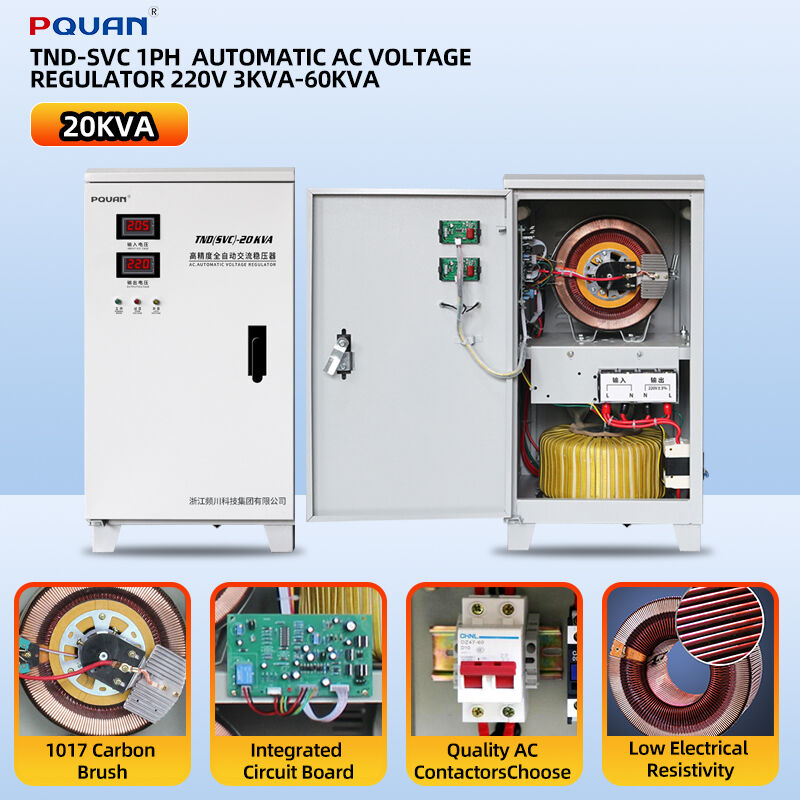
A typical automatic voltage regulator comprises several critical components that work in harmony to deliver stable output voltage. The input sensing circuit continuously monitors incoming voltage levels and transmits this information to the central processing unit. The servo motor mechanism provides the mechanical force necessary to adjust transformer taps or variable transformer positions, while the output monitoring system ensures that corrected voltage remains within specified tolerances.
The transformer assembly forms the heart of most automatic voltage regulator designs, featuring multiple taps or continuously variable configurations that allow for precise voltage adjustment. Protection circuits safeguard the regulator and connected equipment from overcurrent conditions, short circuits, and other electrical faults. Display panels and communication interfaces provide operators with real-time status information and enable remote monitoring capabilities essential for modern automated systems.
Types and Classifications of Voltage Regulators
Servo-Controlled Automatic Voltage Regulators
Servo-controlled automatic voltage regulator systems represent the most common and versatile type of voltage regulation technology. These devices utilize precision servo motors to drive variable transformers or tap changers, providing smooth and accurate voltage adjustment across wide input ranges. The servo mechanism responds to control signals from the electronic feedback system, ensuring that output voltage remains stable even during rapid input fluctuations.
The advantages of servo-controlled designs include excellent regulation accuracy, typically within ±1% of nominal voltage, and the ability to handle significant load variations without affecting output stability. These systems can accommodate input voltage variations of ±15% to ±50% depending on the specific model and application requirements. The mechanical nature of servo systems provides inherent reliability and allows for manual override capabilities in emergency situations.
Static Electronic Voltage Regulators
Static electronic automatic voltage regulator technology eliminates moving parts by employing semiconductor switching devices and electronic transformers. These systems offer faster response times compared to servo-controlled units, with regulation adjustments occurring within milliseconds of voltage deviation detection. The absence of mechanical components reduces maintenance requirements and increases overall system reliability in demanding industrial environments.
Electronic regulators excel in applications requiring high-frequency response and minimal maintenance downtime. However, they typically have more limited input voltage ranges compared to servo systems and may generate harmonic distortion that requires additional filtering. The initial cost of static electronic automatic voltage regulator units is often higher than mechanical alternatives, but lower maintenance costs can provide long-term economic benefits.
Industrial Applications and Use Cases
Manufacturing and Production Facilities
Manufacturing industries rely heavily on automatic voltage regulator systems to protect expensive machinery and maintain consistent production quality. CNC machines, robotic systems, and precision manufacturing equipment require stable voltage to operate within specified tolerances. Voltage fluctuations can cause dimensional inaccuracies, surface finish defects, and premature wear of critical components, leading to costly rework and equipment replacement.
Process industries such as chemical manufacturing, pharmaceutical production, and food processing depend on voltage stability for temperature control systems, pumping equipment, and analytical instrumentation. An automatic voltage regulator ensures that these critical systems maintain optimal performance throughout varying load conditions and grid disturbances. The reliability provided by voltage regulation directly impacts product quality, safety compliance, and operational efficiency metrics.
Healthcare and Critical Infrastructure
Healthcare facilities require uninterrupted power quality for life-support equipment, diagnostic imaging systems, and surgical instrumentation. An automatic voltage regulator forms an essential component of medical facility power systems, working in conjunction with uninterruptible power supplies and emergency generators. These systems must meet stringent reliability standards and provide seamless voltage regulation during normal operations and emergency conditions.
Data centers and telecommunications infrastructure utilize automatic voltage regulator technology to protect servers, networking equipment, and storage systems from power quality disturbances. The economic impact of voltage-related equipment failures in these facilities can reach millions of dollars per hour of downtime. Modern voltage regulators designed for critical infrastructure applications feature redundant control systems, advanced monitoring capabilities, and integration with facility management systems.
Selection Criteria and Technical Specifications
Capacity and Load Requirements
Selecting the appropriate automatic voltage regulator requires careful analysis of load characteristics, including total power consumption, starting currents, and load factor variations. The regulator capacity must exceed the maximum expected load by an appropriate safety margin, typically 20-30% for general applications. Consideration of future load growth and system expansion plans ensures that the selected automatic voltage regulator will provide adequate service throughout its operational lifetime.
Load type significantly influences regulator selection, as inductive loads such as motors and transformers create different challenges compared to resistive or electronic loads. Harmonic-generating loads require special consideration, as they can affect regulator performance and may necessitate additional filtering or oversizing of the regulation system. The duty cycle and operating pattern of connected equipment also impact the thermal design and cooling requirements of the voltage regulation system.
Environmental and Installation Considerations
Environmental conditions at the installation site directly affect automatic voltage regulator performance and longevity. Temperature extremes, humidity levels, altitude, and atmospheric contamination must be evaluated during the selection process. Indoor installations typically allow for standard designs, while outdoor applications may require weatherproof enclosures, enhanced cooling systems, and corrosion-resistant materials.
Space constraints and accessibility requirements influence the physical configuration and mounting options for automatic voltage regulator systems. Floor-mounted units provide easy access for maintenance but require dedicated floor space, while wall-mounted designs save space but may limit serviceability. Ventilation requirements, electrical clearances, and local safety codes must be considered during the planning phase to ensure proper installation and safe operation.
Installation and Commissioning Procedures
Pre-Installation Planning and Preparation
Successful automatic voltage regulator installation begins with comprehensive site preparation and system design validation. Electrical load analysis, power system studies, and coordination with existing protective devices ensure optimal integration with facility electrical infrastructure. Site surveys identify potential installation challenges, access limitations, and any required modifications to accommodate the regulator system.
Power system coordination studies verify that the automatic voltage regulator settings are compatible with upstream and downstream protection devices. Proper coordination prevents nuisance tripping during normal regulation operations and ensures selective operation during fault conditions. Documentation review includes electrical drawings, equipment specifications, and local code requirements that may affect installation procedures and final system configuration.
Mechanical Installation and Electrical Connections
Mechanical installation of an automatic voltage regulator involves precise positioning, leveling, and securing to prevent vibration-related issues during operation. Foundation requirements vary depending on unit size and weight, with larger systems requiring reinforced concrete pads or structural mounting systems. Adequate clearances for ventilation, maintenance access, and electrical connections must be maintained according to manufacturer specifications and local electrical codes.
Electrical connections require careful attention to conductor sizing, termination methods, and protection coordination. Input and output connections must be sized to handle the full rated current of the automatic voltage regulator, with appropriate consideration for ambient temperature and installation conditions. Control circuit wiring, communication cables, and auxiliary connections must be routed and terminated according to manufacturer requirements to ensure reliable operation and electromagnetic compatibility.
Maintenance and Troubleshooting Strategies
Preventive Maintenance Programs
Regular preventive maintenance ensures optimal automatic voltage regulator performance and extends equipment service life. Maintenance schedules should include routine inspections of mechanical components, electrical connections, and control system functionality. Servo motors require periodic lubrication and brush inspection, while electronic components need cleaning and thermal management system verification.
Voltage regulation accuracy testing verifies that the automatic voltage regulator maintains specified output tolerances across the full operating range. Load testing confirms that the system can handle rated capacity without overheating or performance degradation. Documentation of maintenance activities, test results, and any observed abnormalities provides valuable trending information for predicting future maintenance needs and identifying potential reliability issues.
Common Issues and Diagnostic Procedures
Troubleshooting automatic voltage regulator problems requires systematic analysis of symptoms, operating conditions, and system history. Voltage regulation instability may indicate worn servo components, contaminated control circuits, or improper calibration settings. Overheating issues often result from inadequate ventilation, overloading, or failing cooling systems that require immediate attention to prevent equipment damage.
Diagnostic procedures should follow manufacturer guidelines and utilize appropriate test equipment to isolate problems safely and efficiently. Voltage measurements at multiple points in the system help identify regulation circuit issues, while current measurements reveal load imbalances or internal faults. Modern automatic voltage regulator systems often include built-in diagnostic capabilities and alarm systems that simplify troubleshooting and reduce diagnostic time.
FAQ
What is the typical lifespan of an automatic voltage regulator
The lifespan of an automatic voltage regulator typically ranges from 15 to 25 years, depending on operating conditions, maintenance quality, and environmental factors. Servo-controlled units may require more frequent maintenance due to mechanical wear, while electronic regulators often have longer service lives but may require component updates as technology evolves. Proper maintenance, appropriate sizing, and quality installation significantly extend equipment life and ensure reliable performance throughout the operational period.
Can an automatic voltage regulator handle three-phase power systems
Yes, automatic voltage regulator systems are available in both single-phase and three-phase configurations to accommodate various power system requirements. Three-phase regulators can be designed as individual single-phase units or integrated three-phase systems, depending on load balancing needs and cost considerations. Three-phase automatic voltage regulator systems provide independent regulation of each phase or combined regulation depending on the specific application and load characteristics.
What input voltage range can an automatic voltage regulator accommodate
Most automatic voltage regulator systems can accommodate input voltage variations ranging from ±15% to ±50% of nominal voltage, depending on the specific design and technology employed. Servo-controlled regulators typically offer wider input ranges compared to electronic units, making them suitable for areas with poor power quality. The selection of input range should be based on local power system characteristics and expected voltage variation patterns to ensure adequate regulation capability.
How does an automatic voltage regulator affect power consumption
An automatic voltage regulator typically consumes 2-5% of the connected load power during normal operation, with efficiency varying based on regulation requirements and system design. The power consumption is primarily due to control circuits, servo motors, and transformer losses within the regulation system. While this represents an additional power cost, the protection provided to connected equipment and improved system reliability typically justify the energy consumption through reduced maintenance costs and extended equipment life.